Initiatives of the AI Transformation Promotion & Adoption Group
In a Column written by Taku Fujita, Mitsue-Links’ Representative Director (CTO), at the beginning of the year, the topic of “promoting AI Transformation” was introduced. Since then, over the past three months or so, we have been steadily advancing various initiatives. In this Column, I would like to share some of these efforts.
Establishment of the AI Transformation Promotion & Adoption Group
First, we established a cross-functional organization called the AI Transformation Promotion & Adoption Group (hereafter, the AX Promotion Group). This group functions as a hub, similar to an AI Center of Excellence (CoE).
The AX Promotion Group is primarily composed of members from the X-tech Promotion Division, to which I belong. Each member is assigned to a specific department within Mitsue-Links and then works collaboratively to drive AI adoption within.
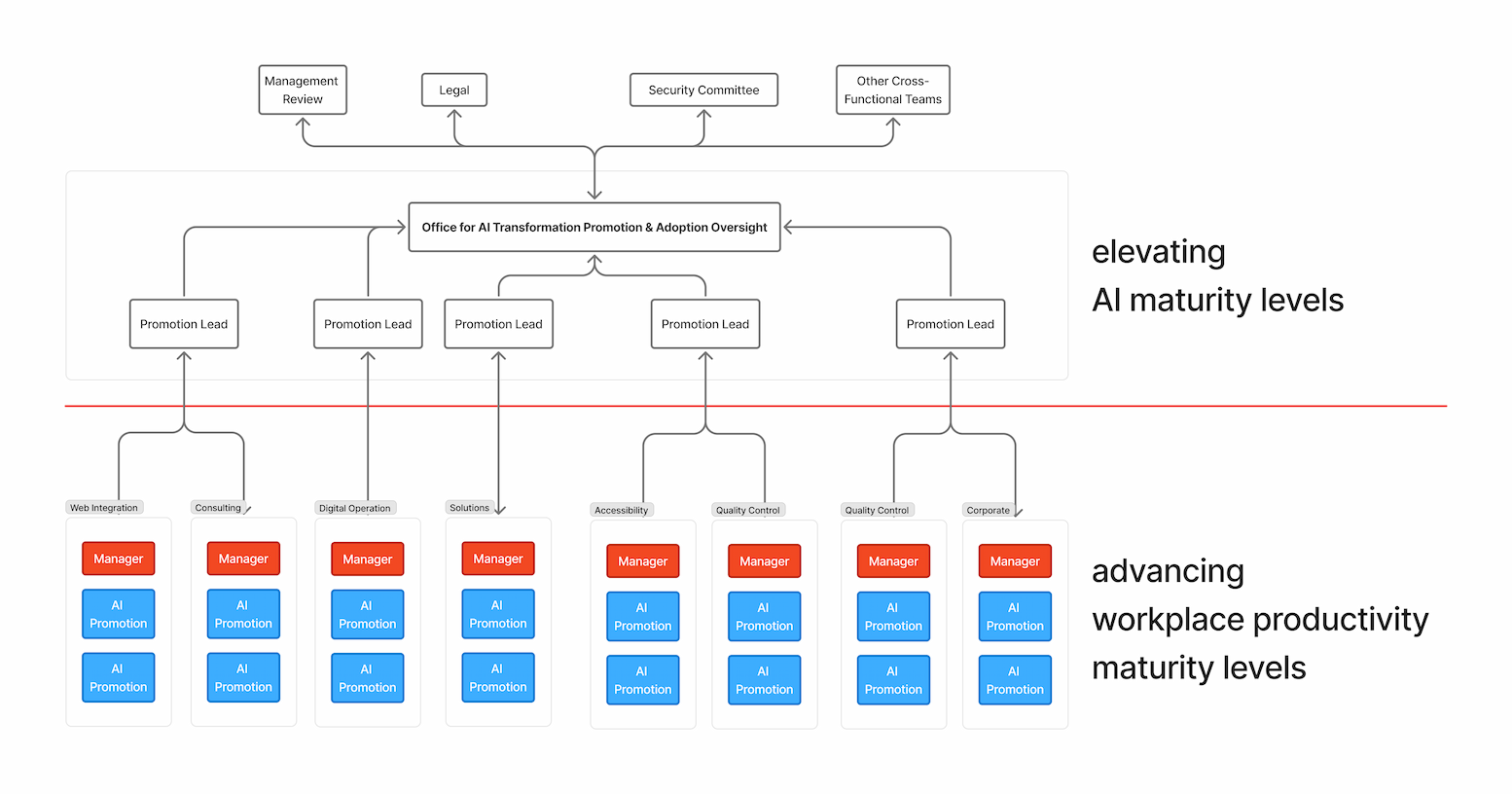
To ensure that initiatives do not end with merely introducing AI tools, responsibilities are divided. Firstly, members of the AX Promotion Group focus on raising the AI maturity level of their assigned departments, the department members then focus on improving their own productivity levels.
Defining AI Maturity Levels
Within any organization, there are varying levels of familiarity with AI – basically, those who use the technology regularly, occasionally, or hardly at all.
Those who actively use AI tend to naturally suggest ideas such as: “shouldn’t we introduce this tool as well?” or “shouldn’t we rethink the workflow itself, not just improve efficiency?”
On the other hand, less experienced users often struggle to envision AI’s practical applications, thinking: “I know it’s powerful, probably useful, but I don’t know how to apply it to my work.”
Differences in maturity levels create misalignment in assumptions, internal discussions, and ultimately impact output and efficiency. Therefore, defining levels and then understanding where each member of the company and their team stands is essential for systematically improving total organizational maturity and enhanced output and performance.
At Mitsue-Links, we define AI maturity levels as follows:
| Level | Definition | Description |
|---|---|---|
| 1 | Individual Enablement | Individuals use AI in their core tasks |
| 2 | Departmental Enablement | AI agents are shared within departments |
| 3 | Transition to Automation | AI begins to take over parts of workflows |
This framework is based on concepts from the book “AI Agents: Machines Collaborating with Humans,(in Japanese)” which defines up to Level 5. In addition to organization-wide levels, for each designated job description, we also define maturity levels for key tasks.
Establishing AI Usage Guidelines and Standardizing Internal Tools
At the end of last year, we conducted an internal survey on AI usage.
While 95% of employees reported using AI, we also received feedback such as “I don’t know which tools I’m allowed to use”, “I’m unclear about company rules”, and “I’m concerned about security.”
Using tools without clear rules can lead to so-called shadow IT phenomenon, where services are used without management awareness. Simply banning AI due to security concerns is no longer practical - in fact, non-use itself is increasingly becoming a risk.
Presently, at Mitsue-Links, we have shifted to a mindset that assumes AI adoption and now focus on methods to use and manage safely. This includes revising guidelines to match current usage and establishing guardrails by designating tools such as Microsoft 365 Copilot and Cursor as standard tools for internal usage.
Going forward, rather than committing to specific technologies, our goal is to create a flexible framework where tools can be introduced, reviewed, updated, and replaced as needed.
Commence with an Assessment
Microsoft recently published a survey of 500 business decision-makers on AI agents, identifying key differences between organizations that have successfully adopted them and those that have not. The study highlights five key differentiators:
- Linking AI agent adoption directly to business outcomes (KPIs)
- Visualizing workflows and clearly identifying where to implement AI
- Establishing data infrastructure with clear quality and ownership
- Rethinking not only workflows but also roles and talent development
- Implementing comprehensive governance, including accountability and oversight
While introducing AI tools and improving individual maturity is a starting point, reaching higher levels requires organizational initiatives. However, many may not know where to begin. To support such initiatives, Microsoft offers an AI Readiness Assessment, which seeks to evaluate an organization’s preparedness across seven dimensions:
- Business strategy
- Organization and culture
- AI strategy and experience
- Data foundations
- Governance and security
- Infrastructure for AI
- Model management
By answering a series of questions, organizations can assess their current state and receive recommendations for improvement.
If you are looking to accelerate AI adoption or are unsure about your next steps, we encourage you to try this assessment. Thank you.
For more information on our services, timeframes and estimates, as well as examples of our work, please feel free to be in touch.